Hotel Corporate Codes — the questions people actually ask
Eight questions that come up every time corporate hotel codes get discussed: do hotels check, can you use one on a personal trip, what happens at the front desk if you cannot prove it. Short answer first, then the detail.
Affiliate disclosure: some links from this site to booking sites may be affiliate links, and we may earn a commission if you book through them. That has no effect on which codes we list. See our Privacy Policy.
- Do hotels check? — Yes, but hotel by hotel, not brand by brand. Most guests are never asked; some properties ask every time.
- What if I cannot prove it? — The hotel can reprice your stay to the best public rate. At the extreme end, people report being turned away at the desk.
- Personal travel? — A gray area, not a right. The agreement belongs to your employer.
- How do I get a code? — From your employer's travel team, or from a membership or association you genuinely belong to.
- A Marriott 20% off code? — We have not been able to confirm one, and no listing we trust states a flat chain-wide percentage.
- The 15–5 rule? — Not a rate rule at all. It is a guest-service greeting standard that Google surfaces next to these queries.
- Wyndham 40% off? — That number is the Travel Advisors rate, not a corporate code. Full explanation.
- How we verify a code — Two independent listings must agree, and every row carries the month it was last checked.
Do hotels check corporate codes?
They do, but there is no chain-wide rule that says when. Verification is a decision made at the property, sometimes by the person standing in front of you, and that is why reports from travellers vary so widely.
We pulled the experiences people posted on Fishbowl when asked exactly this question. A consultant there said that out of more than a thousand Marriott nights, he had been asked once — in Hong Kong. Another said hotels in East Asia check fairly often while he had been asked once in the United States. One described being asked for a printed rate card at a hotel in Illinois, and another said a manager had warned the team off specific properties in California that were known to check. A co-worker of one poster was turned away at a St. Louis Marriott.
What they ask for, when they ask: a company ID or badge, a business card, a work email address, or in rarer cases a rate card. One reply in that thread is the most useful thing in it — the front desk decides what counts as sufficient proof. There is no published list you can prepare against.
What happens if you are asked for proof and cannot show it?
The usual outcome is a reprice: the hotel moves your booking to the best available public or member rate and the negotiated benefits come off. That can mean paying more than the walk-up rate you would have found by comparing first.
The worse outcome is real but uncommon. In the accounts we collected, a guest using a code he was not entitled to was refused at the desk entirely. No brand publishes a policy saying what must happen, so what you get depends on the property.
One thing to be clear about: a code appearing on this site is not permission. We publish what independent listings say; we cannot tell you that you qualify for any of it.
Can I use my company's code on a personal trip?
Treat it as a gray area rather than an entitlement. Corporate rates are negotiated for business travel against a company's volume, and the agreement is between the hotel and your employer — you are using it as an affiliate of that employer, not as its owner.
Some agreements explicitly extend to employee leisure travel, some are silent, and some exclude it. The only way to know which one you have is to ask whoever owns travel at your company. That is a five-minute question internally and an awkward one at a front desk.
Two adjacent cases worth separating out. Government and military rates carry their own rules and often their own eligibility checks, and they are not part of what we track here. Membership and association codes — alumni associations, unions, purchasing co-operatives — sit in the same booking field but are a different mechanism entirely: you qualify by belonging, not by being employed.
How do I get a corporate code?
- Ask your employer first. Most codes in circulation are internal: they live in the travel policy, the booking tool, or an intranet page, and the company never publishes them. This is the route that actually works and the one people skip.
- If your employer has no agreement, it can negotiate one — usually once travel volume justifies it. Hilton, Marriott and IHG all run their own small-business programmes that sit alongside negotiated codes rather than replacing them.
- Check what you already belong to. Universities, professional bodies, unions and buying groups negotiate rates for their members, and those go in the same field on the booking form as a company code.
- Phoning a hotel and asking for “the corporate rate for [company]” only works if that agreement is already loaded for that property. There is no master list the desk agent can look you up in.
Each brand puts the field in a different place and calls it something different — Marriott labels it Corp/Promo Code or SET#, Hilton uses Corporate Account, IHG calls it Corporate ID. Our brand pages give the click path for each one.
Can anyone use these codes?
Anyone can type one into the field. Most booking forms accept the entry and show a rate without checking anything at the point of booking, which is why the codes spread so widely once they are published.
That is a property of the form, not a statement about entitlement. The rate that comes back is priced on an agreement you may not be party to, and the check — if there is one — happens later, at the hotel.
Is there a Marriott 20% off code?
We have not been able to confirm one, so we are not going to print a number. Across ten brand pages we have 206 codes that two or more independent listings agree on; 65 of them are Marriott. Not one of those listings states a flat chain-wide percentage attached to the code, and our tables deliberately do not publish a discount figure, because the listings almost never state one and a made-up percentage is worse than none.
What is true instead: a corporate rate is a percentage off a reference rate that varies by brand tier, by property and by date, and it can be withdrawn for specific dates. Two people using the same code at the same brand can genuinely get different numbers.
What is the 15–5 rule at Marriott?
It has nothing to do with corporate codes. It is a guest-service greeting standard — acknowledge a guest at a distance, greet them when they are close. Sources do not even agree on the units: some describe it in feet, some in minutes.
We are answering it only because Google keeps showing it next to Marriott corporate-code searches, which makes it look like a rates rule. It is not one, and it affects neither eligibility nor pricing. If a page tells you the 15–5 rule governs your corporate rate, it is confusing two unrelated things.
What is the Wyndham corporate code for 40% off?
There is no 40%-off corporate code. That number is Wyndham's Travel Advisors rate — a discount for travel professionals who have completed Wyndham's own programme, applied to their personal travel. It is not a company-negotiated code and it is not available by entering a number.
The codes on our Wyndham page are association and membership codes, a different mechanism with its own eligibility. The coupon sites that advertise “Wyndham 40% off” are re-describing the advisor rate. We wrote it up in full there.
“List of X corporate codes” — nine searches that ask for one, and what a list can carry
In the ninety days from 27 July to 25 October 2026, Google counted 25 impressions from nine searches that all ask for the same thing — a list. They read list of hilton corporate codes, marriott corporate code list, choice hotel corporate code list, wyndham corporate code list pdf and five more of that shape. Not one of the nine drew a click. The list exists, it is public, and it is 206 confirmed rows across ten pages on this site, one page per hotel group or brand. This is where each part of it lives.
One of the nine deserves reporting on its own. marriott corporate code list sat at an average position of 1.7 — the top of the first page — and still took no clicks from three impressions. We are not going to talk that into a result. We are going to answer the question.
| Page | Confirmed rows | Check-first rows |
|---|---|---|
| Marriott | 65 | 60 |
| Hilton | 41 | 4 |
| IHG | 30 | 15 |
| Hyatt | 27 | 59 |
| Holiday Inn | 22 | 16 |
| Wyndham | 13 | 38 |
| Comfort Inn | 3 | 21 |
| Choice Hotels | 3 | 32 |
| Hampton Inn | 2 | 33 |
| Best Western | 0 | 5 |
| Total | 206 | 283 |
Confirmed = two or more independent listings agree on the code. Check-first = one listing only, listings that disagree, or a source that marks the code unverified. Counted 1 November 2026 from each page's own table.
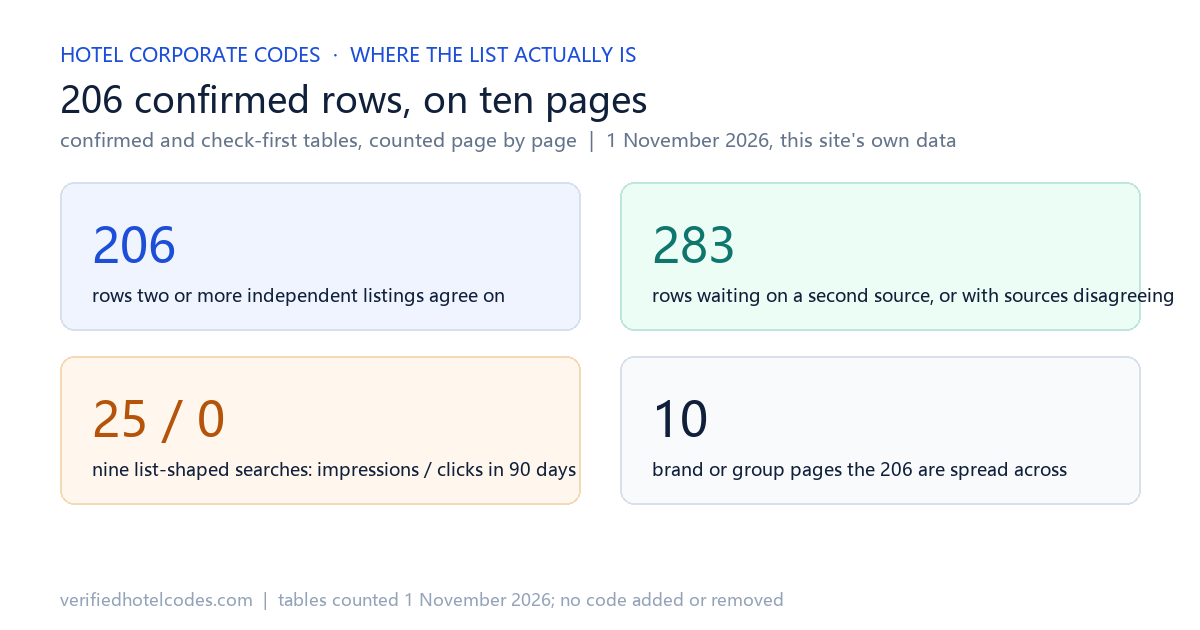
How the 206 are spread. Marriott alone carries 65 of them, just under a third of the total, and Hilton carries 41 against only four rows it cannot confirm — the cleanest ratio on the site. On four of the ten pages the confirmed table is the larger one: Marriott, Hilton, IHG and Holiday Inn. On the other six the check-first table is larger, and on one of them — Hampton Inn (2 against 33) — it is larger by more than fifteen to one. Choice Hotels left that group on 1 November 2026, when a row moved into its confirmed table: three against 32, a ratio of about eleven to one. Best Western has no confirmed row at all: five candidates, every one of them from a single source.
Choice’s two pages now carry the same three rows. Comfort Inn has three confirmed rows and its parent, Choice Hotels, has three — the same three. ABN (Allied Business Network) and Harvard University appear on both, written 00845160 / 845160 and 00076514 / 76514, the same IDs with leading zeros. The third is my Better Benefits (00194080), which sat on the Comfort Inn page alone until 1 November 2026, when we recounted the Choice page’s own sources and found the second listing we had missed. It is now on both. In October we wrote that we would not move it between pages to make the numbers agree, and we have not: the row moved because the count behind it was wrong, not because the totals looked untidy.
Why it is ten pages and not one, and why there is no PDF. One of the nine searches asks for the Wyndham list as a PDF. There isn't one, for the same reason the 206 are not on a single page: a row here is not just a company and a number. It carries the month the code was last checked and the number of independent listings behind it, and those two are what let you decide whether to trust it on your dates. A flat file cannot carry them, and a PDF starts going stale the day it is saved. Google's own answer panel asks this about Hilton too; the answer there is the same one.
Two things to watch when reading the total. First, three of the ten pages are brand-level pages inside a group that also has its own page — Holiday Inn inside IHG, Hampton Inn inside Hilton, Comfort Inn inside Choice — so their rows are not additions to the group's rows; they are the same agreements seen one level down. Second, 206 counts rows, not employers: 32 employers come back on two or more of these pages, which we counted sideways on the home page.
And it checks against the section below. The verification section on this page, written in September 2026, reports 202 confirmed codes across nine pages and 284 in the check-first tables. Today's 206 is that same 202 plus the three rows on the Comfort Inn page, which opened on 29 September 2026, after this page was written, plus one row that moved up out of the Choice check-first table on 1 November 2026. The check-first total fell to 283 for exactly the same reason, as did the single row one source marks unverified.
Tables counted 1 November 2026 from this site's own brand pages. Last checked: November 2026. One row moved from a check-first table into a confirmed one on /choice; no code was added or removed.
The same box, six names — what each group calls the field a corporate code goes in
In the ninety days from 29 July to 27 October 2026, Google counted 35 impressions from fifteen searches that all ask for the same thing by the name of the box it goes in. Fourteen are English — holiday inn corporate id, ihg corporate id, hilton corporate account code, marriott corporate rate code, comfort inn corporate rate and nine more of that shape — and one is Chinese. Between them they drew one click. The answer is the same for all fifteen: that box has no universal name, and there is no code called “the corporate id” that works everywhere.
Ten pages on this site, one per group or brand, and each one sends you to a different string. Six distinct names in all, and one page — Best Western — that names the place rather than the field. Here is what each page tells you to look for, quoted from that page.
| Page | The name on that form | Note |
|---|---|---|
| Hilton | Add Special Rates → Corporate Account | rate type and field carry the same two words |
| Hampton Inn | Add Special Rates → Corporate Account | same label as the Hilton page |
| Marriott | Corp/Promo Code or SET# | the name on Marriott's own help page |
| IHG | Corporate ID / Corporate or Group Code | the group-wide box |
| Holiday Inn | Rate Preference → Corporate Code | same group as IHG, different label |
| Hyatt | Special Offer Code and/or Corporate or Group Code | one field, two names inside one label |
| Wyndham | Special Rates → Corporate Code | some listings write it Corporate/Promo Code |
| Choice Hotels | Special Rate / Corporate ID | some listings write it Corporate/Promo Code |
| Comfort Inn | Special Rate / Corporate ID | the same box as the Choice Hotels page |
| Best Western | — | no field name; the Corporate section of the Rates dropdown |
Field names are quoted as each page prints them and are left in English on every language version of this site: the label is what you have to match on the booking form, and a translated label is a label you cannot find. Counted 29 October 2026 from this site's own pages, and from Google Search Console for the 90 days to 27 October 2026.
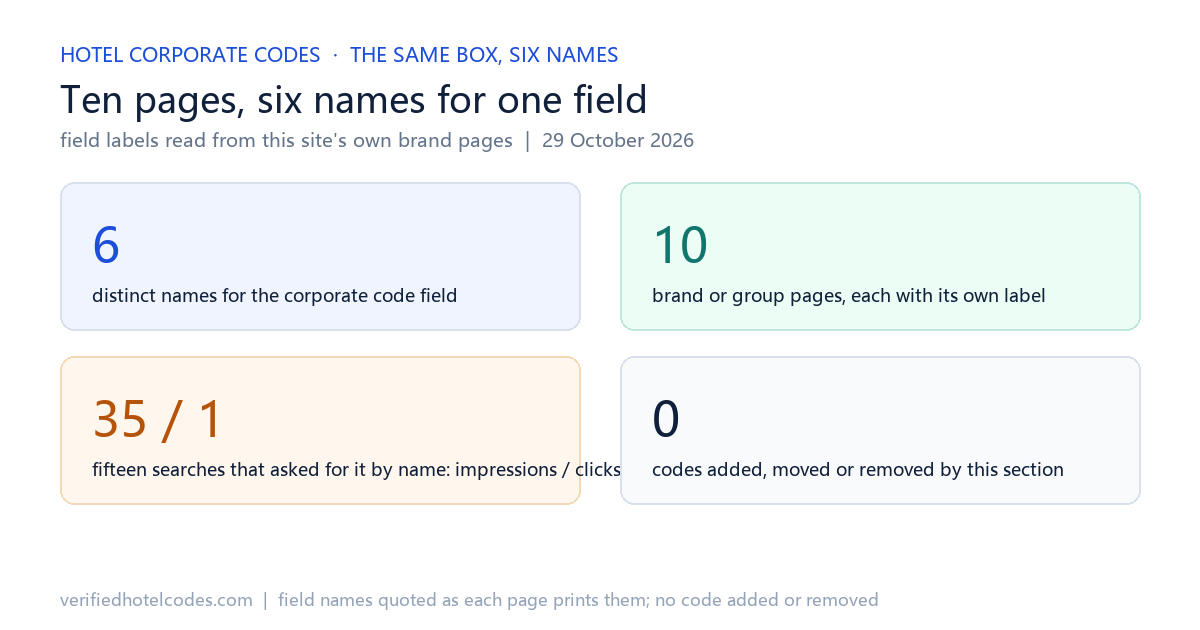
What the six have in common. Every one of them contains the word Corporate. What changes is the second noun: Account at Hilton, ID at IHG and Choice, Code at Holiday Inn and Wyndham, Rate at Choice, Promo at Marriott. One label carries a token that is not a word at all — Marriott's SET# — and it is the only one of the six that a group defines on its own help page rather than only on the form.
One group, two labels. Our IHG page sends you to the Corporate ID / Corporate or Group Code field. Our Holiday Inn page — same group, same booking engine, same numbers underneath — calls it Corporate Code, and adds that it is sometimes shown as Corporate ID on partner landing pages. Nothing was renamed: the label depends on which page you land on. The reverse happens too. Corporate Code is the only string used by two different groups, IHG's Holiday Inn box and Wyndham's.
A shared label is not a shared list. Hampton Inn uses Hilton's label, Corporate Account, on the same form. It is not the same set of numbers: none of the 35 on our Hampton Inn page begins with a letter, against 36 of the 69 on our Hilton page. The word on the form is inherited; the codes behind it are not.
The page with no label is also the page with no confirmed codes. Best Western's page tells you to open the Rates dropdown and go to the Corporate section, without naming a field, and its confirmed table is empty: five candidates, each from a single source. We report both facts on the same page and we are not claiming one causes the other.
The only search of the fifteen that is not English is the only one that clicked. ihg 公司識別碼 — IHG, company identifier — had ten impressions at an average position of 4.6, the best of the fifteen, and one click. It is asking for the same thing the English ones ask for: the IHG Corporate ID, which is what every number on our IHG page is.
Why the labels are not different products. A code your employer issued works in exactly one group's box. Type a Hilton Corporate Account into the Corp/Promo Code or SET# field on marriott.com and nothing comes back, because the number is a key to one agreement between one employer and one group. The label is worth knowing only because it tells you where to type, not what to type — and there is no version of it that is public. If you are looking for the number itself, start from the group your employer has an agreement with.
Where each of the fifteen lands.
| Search, as typed | Impressions | Avg. position | The name it was looking for | Answered on |
|---|---|---|---|---|
| ihg 公司識別碼 | 10 | 4.6 | Corporate ID | ihg |
| special rate: 54749 | 6 | 4.7 | Special Offer Code | hyatt |
| comfort inn corporate rate | 4 | 36.5 | Special Rate / Corporate ID | comfort-inn |
| holiday inn corporate id | 2 | 22.0 | Corporate Code | holiday-inn |
| hilton corporate account code | 2 | 49.5 | Corporate Account | hilton |
| hilton corporate account codes | 2 | 59.5 | Corporate Account | hilton |
| choice hotels corporate rate | 1 | 32 | Special Rate / Corporate ID | choice |
| ihg corporate id | 1 | 35 | Corporate ID / Corporate or Group Code | ihg |
| hilton corporate account number | 1 | 41 | Corporate Account | hilton |
| comfort inn special rate code | 1 | 44 | Special Rate / Corporate ID | comfort-inn |
| marriott corporate rate code | 1 | 46 | Corp/Promo Code or SET# | marriott |
| corporate rate codes for hilton | 1 | 49 | Corporate Account | hilton |
| corporate id ihg | 1 | 50 | Corporate ID / Corporate or Group Code | ihg |
| hilton corporate rate codes | 1 | 54 | Corporate Account | hilton |
| hilton rate codes | 1 | 55 | Corporate Account | hilton |
| Fifteen searches | 35 | — | six | — |
One click in total, from the Chinese query. The two best-placed searches of the fifteen both sit on the first page — 4.6 and 4.7 — and thirteen of the fifteen sit between position 22 and 60.
Field names read 29 October 2026 from this site's own brand pages; search data from Google Search Console, 90 days to 27 October 2026. Last checked: October 2026. No code was added, moved or removed.
How we check a code before it goes on this site
- We pull each code from several independent public listings. A code reaches a verified table only when at least two independent listings agree on it.
- One listing only, listings that disagree with each other, or a listing that flags the code as unverified — all of those go to a “check before relying on it” table instead, never to the verified one.
- Every row carries the month that code was last checked, so you can judge how stale it might be.
- Numeric codes are compared with leading zeros stripped, because listings pad them inconsistently. Prefixed codes keep their prefix.
- We do not test codes against a live booking engine, and we do not guarantee a code works on your dates.
As of the September 2026 pass, that process leaves 202 codes cleared by two or more independent listings across the site, 284 in the check-first tables, and one flagged expired. Those numbers are small on purpose.
Which sources we drop, and why
This is the part that makes the tables short, and it is worth stating plainly:
- A source is discarded whole if its codes look generated rather than negotiated — placeholder values, or a run of codes stepping up in a fixed arithmetic sequence. We do not cherry-pick the suspicious rows out of it.
- A source that is a subset of another site's list is a derivative copy and adds no independent confirmation.
- Pages that return a 200 response but render “Brand Not Found” are empty shells, not sources.
- One source is permanently blacklisted for the pattern above. When we drop a source, we say so on the affected brand page rather than quietly shrinking the table.
Questions on this page were collected from Google's People Also Ask boxes on 26 September 2026, using a signed-in browser. Last updated: September 2026.