How we verify a hotel corporate code
Every code on this site is decided by one rule — at least two independent public listings have to agree on it. This page is that rule written out in full: what we read, what we throw away, and the specific cases that made us set the bar where we did.
The rule
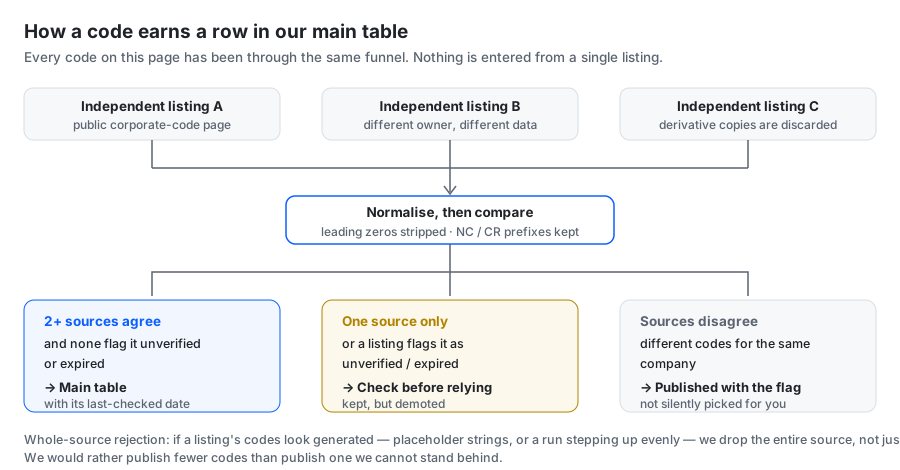
Across the site, 206 codes have cleared the same bar. It has three outcomes and no exceptions:
- Two or more independent listings agree on the company and the digits — the code goes into the main table, with the number of listings behind it.
- Only one listing carries it — it goes into a check-first table and is never described as verified, however plausible it looks.
- A listing flags its own row as unverified, or reports the code expired — it comes out of the main table even if other listings still print it.
The word doing the work in that first line is independent, and most of this page is about what it means in practice.
Two things we do not do, stated up front, because they set the limits of every claim here: we do not test codes at a live booking engine, and we have no private feed or insider list. Everything on the site comes from public listings that we cross-check against each other. That means we can tell you a code is well corroborated. We cannot tell you it will return a rate on your dates.
How many listings actually stand behind each of the 206
We counted the confirmed table on all ten brand and group pages on 1 November 2026, straight off the published tables: 206 rows in total, and the column that records how many independent listings agree on each one. The distribution is not flattering to our own rule. 107 of the 206 — just over half — rest on exactly two listings, which is the minimum, not a typical value. 58 rows rest on three, 30 on four, and only eleven on five or more (seven on five, three on six, one on seven).
The two pages that look most alike are not shaped alike at all. Hilton is the only page on the site where no row falls below three listings — its 41 confirmed rows are backed by 12 lists (three), 18 lists (four), seven lists (five), three lists (six) and one list (seven), and that last one, AT&T with seven independent listings, is the most corroborated row anywhere on this site. Marriott sits at the other end: 65 confirmed rows, and 49 of them rest on exactly two listings. Same rule, same threshold, two completely different shapes. Best Western has no confirmed rows at all, which is also a shape — the rule is allowed to produce nothing.
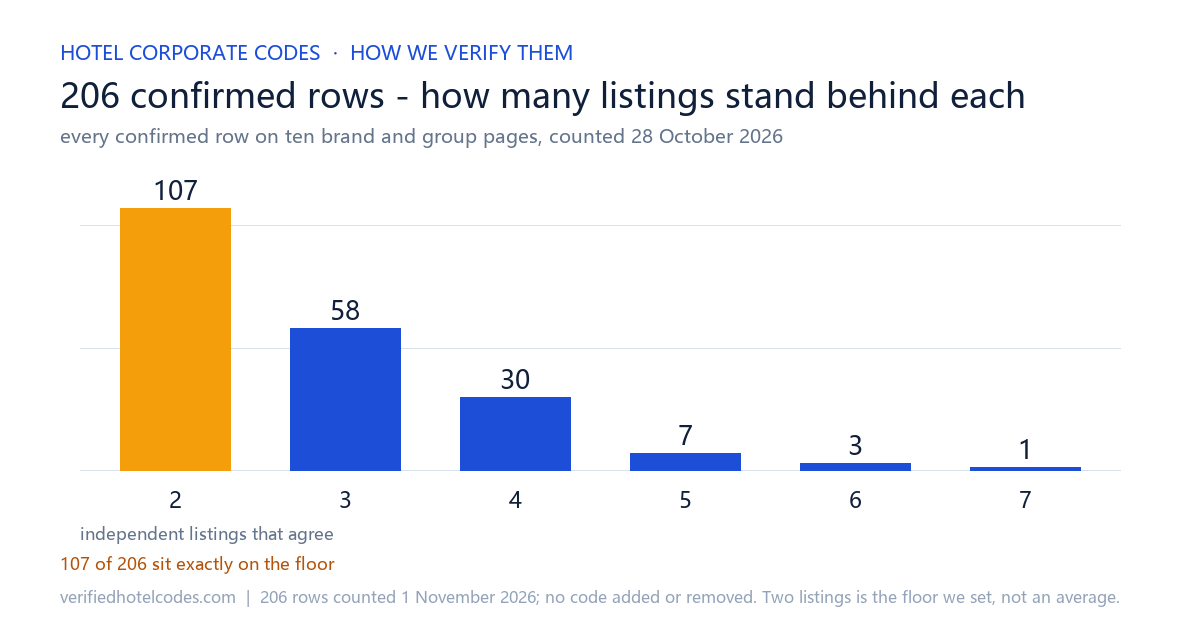
So read the Confirmed in column as a floor, not as a score. Two listings is the number we insist on before a row is allowed to carry the word confirmed, and the 107 rows sitting on it are not better corroborated than the 30 sitting on four. What the column does tell you is how far a row can be checked by someone who does not trust us: a row backed by seven independent listings is one you can test against six other places, and a row backed by two is one where a single wrong listing is enough to break it. We do not test codes at a live booking engine, so this number is the closest thing we have to a quality measure — and it is the only column in any of our tables that varies.
Source counts checked 1 November 2026 against the published tables on all ten brand and group pages.
What counts as a source
Four kinds of listing get read, in descending order of how much they are worth:
- The association or discount network's own page. ABN (Allied Business Network) publishes its own ABN codes — that is the organisation's own document, not somebody's summary of it.
- Points-and-miles write-ups that show their working. milepro and goingawesomeplaces are useful less for their tables than for the fact that they explain where a row came from.
- Large aggregator tables. corporate-codes.com is the biggest of these, and the most copied.
- Benefit pages an organisation writes for its own members. mybetterbenefits carries employer-specific codes that appear nowhere else.
The last two are useful but never sufficient on their own. An aggregator table is usually compiled from other listings, so two aggregators agreeing with each other is often one source agreeing with itself. That is the trap this whole method is built to avoid.
So the test we apply to a listing is not whether it looks professional. It is whether it shows where its rows came from, or whether it just prints a table. A table with no provenance can still be right — but nothing about it lets you tell a right row from a copied one.
Three patterns that get a listing thrown out
Plenty of listings get discarded, and each of the three patterns below is a real case from this site rather than a hypothetical:
- Derived copies. hotelcorporatecodes.com carries eleven Best Western codes, and all eleven of them are already in corporate-codes.com's list, in the same order. That is one source counted twice, not two sources agreeing.
- Machine-generated rows. codescorporate.com lists Apple as holding Best Western code 0000000, and runs a sequence of US state codes climbing in even steps. When a listing shows that shape we discard the entire listing, rather than delete the obviously fake rows and trust what is left.
- Shells and coupon pages. hotel-corporate-code.com returns a 200 for its Comfort Inn page with the words "Brand Not Found" in the body. Coupon pages sell seasonal promotions, which are a different product from a negotiated corporate rate.
Dropping the whole listing rather than the bad rows is deliberate. If a source cannot tell a placeholder from a code, the rows it happened to get right are not evidence either — there is no way to know which rows those are.
Why "it appears in ten listings" is not evidence
This is the most common mistake in this niche, and it is worth walking through slowly. Code pages cite each other constantly. A list goes up on one site, gets summarised on a second, gets copied row for row into a third aggregator, and a forum post quotes the third. A search for the code now returns ten results. Nothing has been verified ten times. One claim has been repeated ten times.
Two signs give a copy chain away, and both are visible from outside:
- Same order, same omissions. The eleven Best Western codes above appear in the same sequence in both lists, missing the same companies. Independent work does not come out in the same order with the same gaps.
- Same wrong code, same company. When two listings give the same company the same wrong number, and nobody else gives that company anything, the second one is downstream of the first.
The practical consequence: a code is never promoted here because it is widely reported. It is promoted because the listings carrying it can be traced to different origins. A code carried by three copies of the same list is still a one-source code.
The disagreements we actually hit
This is the part most code pages leave out entirely. Public listings disagree constantly — about the digits, about which company a code belongs to, and about how much it saves. Seven cases we hit while building the brand pages:
- Florida International University — one listing gives the Choice ID as LFIU, another as 803291. Both sit in the check-first table; neither is confirmed.
- AkzoNobel and ABN (Allied Business Network) — four listings give the Wyndham code 8000000066 to ABN, and one gives the same number to AkzoNobel.
- Business Advantage Plus — circulates at Wyndham as both 1000007964 and 1000008537, and one listing hands 1000008537 to S&T Bank instead.
- General Electric — two different Best Western codes are in circulation, 322510 and 01648620, and the second is flagged unverified by the listing that carries it.
- Apple — appears in one Best Western list as 0000000, a placeholder, published as though it were a code.
- University of Washington — Q61N is a rate code for one property, Hotel Nexus in Seattle, not a chain-wide Best Western corporate code. It gets copied into chain-wide lists anyway.
- Century 21 — the number 803277 is filed under "Century 21 Business" in the Choice lists and under Wyndham's "Century 21 System" in another.
Two lessons follow, and they are the reason this site looks the way it does. First, the number of listings a code appears in is not evidence: when listings copy each other, ten of them count as one. Second, a code can be perfectly real and still be the wrong shape for you.
A real code can still be the wrong shape
Not every disagreement is an error, and not every real code is usable as a chain-wide one. Four examples from the brand pages:
- A single property's rate code. University of Washington's Q61N is a rate code for Hotel Nexus in Seattle. It is not a Best Western corporate code, and it does not work at other Best Westerns — but it is copied into chain-wide lists regardless.
- A placeholder. Apple's 0000000 is padding somebody published as a code.
- A format that hides errors. Marriott prices on letters, not numbers — ACC for Accenture, DTC for Deloitte, AMX for American Express. A wrong letter code looks exactly as plausible as a right one, which is why all twelve disagreements on the Marriott page are letter codes: Pfizer PFE against PFZ, Shell SHL against SHE.
- A number filed under several owners. On the IHG page, 109193 is filed under EY, under Exterran and under Facebook by three separate listings. A collision there is not automatically an error, which is why those have to be read one case at a time.
The point of listing them is that "verified" and "works for you" are different claims, and only the first one is ours to make.
Why the date matters more than the code
A corporate code is a number attached to a company's negotiated agreement. Agreements get renegotiated, companies get acquired, a travel manager changes the code, and the old one stops returning a rate — usually without anyone publishing that fact.
A list without dates looks complete and goes stale silently. That is the gap this site exists to close, and it is why every table here carries the month it was last checked, and why codes flagged expired are moved out of the main table rather than left sitting in it.
What we do not do
- We do not book, test, or call hotels to check codes.
- We do not know whether you are eligible for any given rate. That is between you and the company whose code it is.
- We do not guarantee that any code returns a rate on any date.
- We do not accept payment for placement. Some outbound links are affiliate links, and that is disclosed on every page.
A code appearing here is not permission to use it, and it is not a statement that the rate is available. If a hotel decides you do not qualify, it can reprice the booking.
Where this method shows up on the brand pages
Each brand page carries its own version of this note, because the problems are different per group:
- Marriott — the largest pair of tables on the site (65 confirmed, 60 check-first) and the clearest case of a code format making verification harder.
- Hilton — the only group here where the corroboration problem is close to absent, because two of the anchor documents are primary sources rather than aggregators.
- IHG — 30 confirmed against 36 check-first, and a long list of numbers filed under more than one company.
- Hyatt — 27 confirmed against 59 check-first; almost every disagreement is a number filed under several companies.
- Holiday Inn — 22 confirmed, 16 check-first, and every check-first entry single-sourced.
- Hampton Inn — the smallest verified table on the site: two numbers, against 33 check-first entries that all come from one list.
- Wyndham and Choice Hotels — 13 and 2 confirmed against 38 and 33 check-first, where the check-first table is the honest answer.
- Best Western and Comfort Inn — the pages that say out loud that no code has been confirmed by two independent listings yet, and point you at the loyalty rate instead.
If you want to catch us out, the fastest route is on one of those pages: find a code we have marked confirmed, and find a listing that contradicts it. That is a report worth sending — the contact page explains what makes one usable.
Last updated: October 2026.